Intersections of Chance: Mapping Probability Flows Between Craps Dice Sequences, Video Poker Hand Cycles, and Bingo Pattern Grids in Multi-Venue Settings
Written by Nils Patterson · Oct 3, 2026
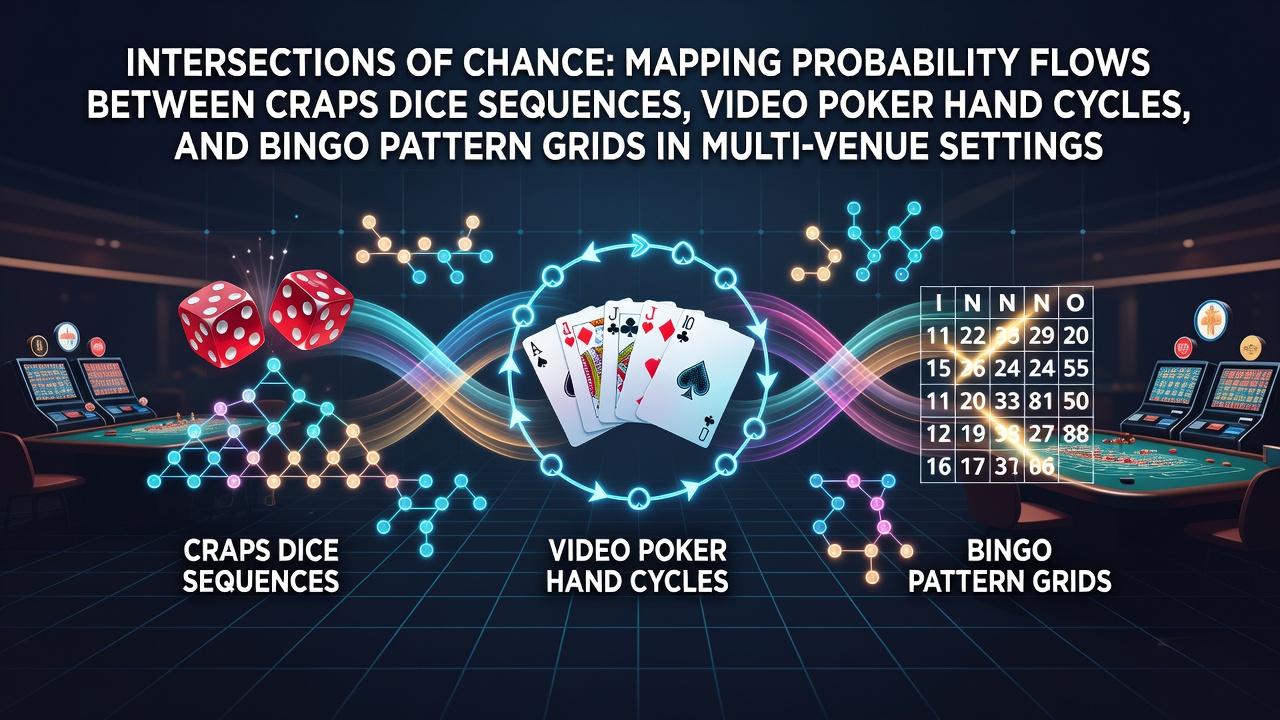
Intersections of Chance: Mapping Probability Flows Between Craps Dice Sequences, Video Poker Hand Cycles, and Bingo Pattern Grids in Multi-Venue Settings
Probability calculations in casino environments often operate independently across game types yet observers note measurable intersections when players move between craps, video poker, and bingo within the same venue or across connected locations. Data from multiple jurisdictions shows that dice outcome sequences in craps follow fixed combinatorial structures while video poker hand cycles rely on shuffled deck permutations and bingo pattern grids depend on randomized number draws within fixed matrices. When these systems run concurrently, analysts track how individual probability streams influence overall session variance without altering core game mathematics.
Craps Dice Sequences and Their Baseline Distributions
Craps relies on two six-sided dice producing 36 equally likely outcomes per roll, with the number seven appearing six times and therefore carrying a probability of 6/36 or 1/6. Sequences extend across multiple rolls where each outcome remains independent, yet players observe streaks and clusters that researchers quantify through Markov chain models. Multi-roll bets such as place numbers or hardways accumulate probabilities across successive independent trials, and studies of large datasets confirm that long-run frequencies align closely with theoretical expectations even when short-term deviations occur.
Video Poker Hand Cycles and Cycle Length Analysis
Video poker machines generate hands from a 52-card deck minus any cards already dealt, creating cycle lengths determined by the total number of possible five-card combinations after the initial deal and draw. Jacks or Better variants, for example, produce specific return percentages based on paytable structures, and cycle analysis reveals that full cycles can span thousands of hands before all combinations repeat. Observers tracking multi-machine floors note that simultaneous play across several terminals distributes these cycles across independent random number generators, which prevents direct overlap yet allows aggregate variance patterns to emerge when players rotate between stations.
Bingo Pattern Grids and Draw Sequence Probabilities
Bingo operates on 5x5 or similar grids where numbered balls are drawn without replacement until predefined patterns complete. Each pattern carries a distinct probability curve that changes as draws progress, with early patterns such as single lines requiring fewer matches than complex shapes covering multiple rows and columns. In multi-venue bingo operations that link several halls through centralized draw systems, the same sequence feeds multiple grids simultaneously, creating shared probability flows that operators monitor for regulatory compliance. Figures released by the Alcohol and Gaming Commission of Ontario indicate that linked bingo sessions in 2025 maintained consistent pattern completion rates across venues despite varying player volumes.
Mapping Overlaps in Multi-Venue Environments
When facilities offer craps, video poker, and bingo in adjacent areas, probability flows become relevant for session-level modeling rather than individual game outcomes. A player completing a bingo pattern may immediately transition to a video poker terminal, where the independent hand cycle begins anew, yet aggregate data from floor-wide monitoring systems capture how time spent in one game correlates with exposure to another. In October 2026, several North American properties plan to release updated session analytics that integrate these cross-game datasets, allowing researchers to examine whether dice sequence lengths in craps influence subsequent poker cycle selections or bingo grid completion speeds. Such mappings rely on timestamped transaction logs rather than causal mechanisms between games.

Industry reports from the Australasian Gaming Council highlight that multi-venue operators increasingly deploy unified random number generator audits to verify independence across game types while still documenting session-level statistics. These audits confirm that no mechanical linkage exists between a craps dice sequence and a bingo number draw, yet the combined distribution of outcomes across an evening can exhibit measurable clustering when large numbers of participants move between stations. Researchers apply multivariate statistical techniques to separate genuine intersections from random coincidence.
Regulatory and Data Collection Practices
Gaming regulators require operators to maintain separate probability integrity for each game while permitting aggregated reporting on player movement. Canadian provincial frameworks and certain U.S. state gaming boards both mandate that any shared infrastructure, such as central servers for bingo or linked progressive systems, undergoes testing to ensure one game's random process does not affect another. Data collected through these channels provides the raw material for mapping probability flows, because timestamped records allow analysts to reconstruct sequences of game participation without implying predictive power.
Conclusion
Probability flows between craps dice sequences, video poker hand cycles, and bingo pattern grids remain mathematically independent at the individual game level, yet multi-venue settings generate observable aggregate patterns when participation data is combined across locations and time periods. Ongoing data collection efforts scheduled for release in late 2026 will supply additional empirical material for researchers examining these intersections through statistical rather than predictive lenses.